
Table of Contents
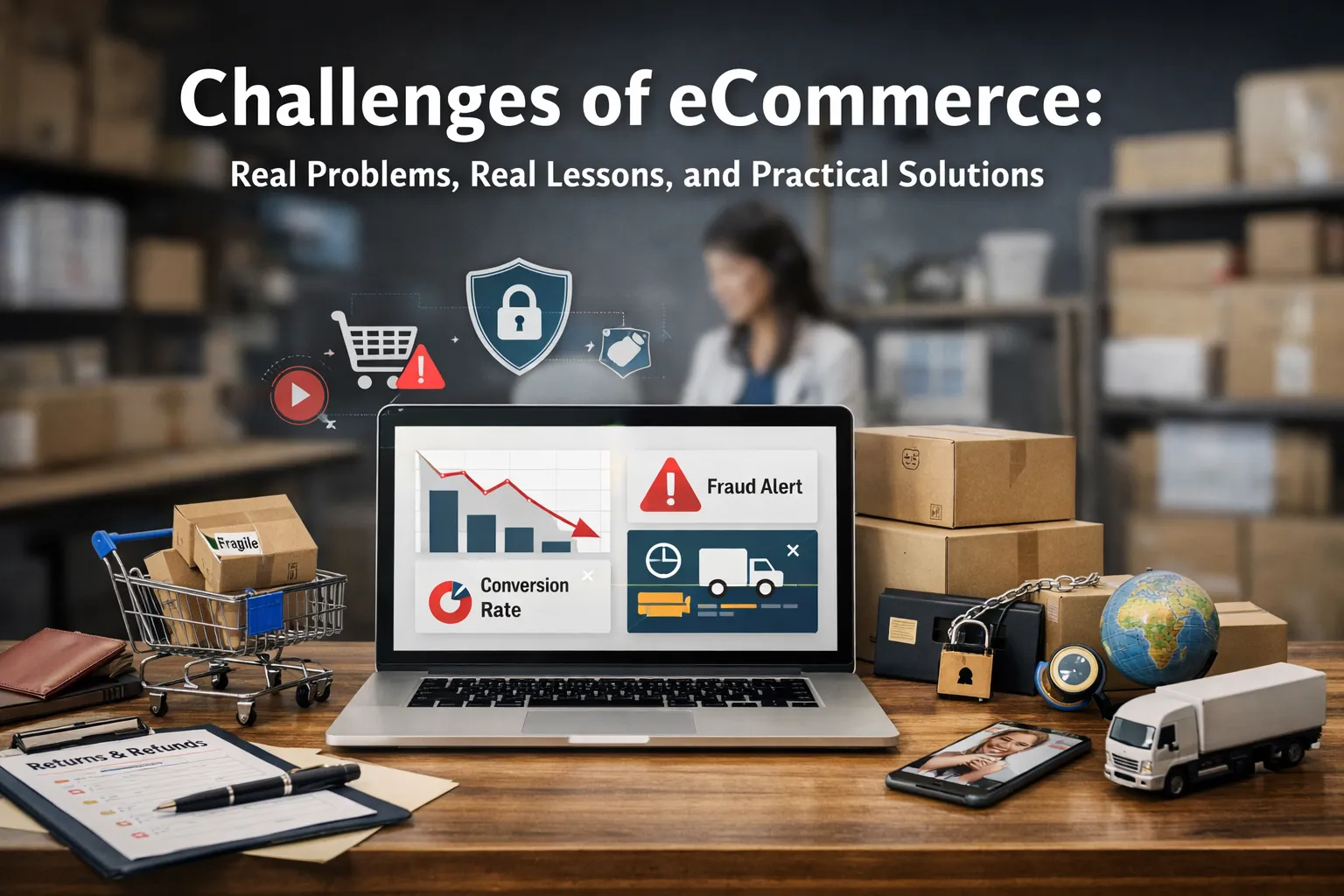
ToggleeCommerce looks glamorous from the outside—low entry barriers, global reach, and automation-driven scale. But anyone who has actually built, managed, or advised an online store knows the truth: eCommerce is hard. The challenges of eCommerce are layered, interconnected, and unforgiving if you get the fundamentals wrong.
I’ve worked with small Shopify stores struggling to get their first 100 orders and mid-sized eCommerce brands burning five figures a month on ads without profits. The pattern is always the same: tools are not the problem, traffic is not the real problem, and “more marketing” is rarely the solution. The real issues lie deeper—in trust, operations, expectations, and execution.
This article breaks down the core challenges of eCommerce, why they exist, how they evolve, and what actually works to overcome them. No recycled content. No surface-level advice. Just hard-earned insights, real examples, and practical solutions that scale.
The Biggest Challenges of eCommerce Today
1. Conversion Rate Optimization Is Harder Than Ever
Getting traffic is no longer the main battle. Converting that traffic is.
Modern users are skeptical, impatient, and comparison-driven. They open ten tabs, compare prices, read reviews, check delivery times, and leave without buying if anything feels “off.”
In my experience, most stores don’t have a traffic problem—they have a clarity problem. Poor product descriptions, weak social proof, confusing checkout flows, and slow pages kill conversions silently.
What actually moves the needle is not fancy design but decision simplicity. Clear value propositions, honest product benefits, transparent pricing, and frictionless checkout outperform gimmicks every time.
2. Online Identity Verification and Fraud Risks
Fraud is one of the most underestimated challenges of eCommerce, especially for growing stores.
As order volume increases, so does exposure to:
- Fake accounts
- Stolen cards
- Chargebacks
- Friendly fraud
Many store owners learn this lesson the hard way—after payment processors freeze their funds.
The real challenge is balance. Overprotect, and you block genuine customers. Under-protect, and fraud eats your margins. Smart verification flows, adaptive risk scoring, and manual review for edge cases are unavoidable once you scale.
3. Rising Consumer Expectations
Amazon didn’t just raise the bar—it shattered it.
Today’s customers expect:
- Same-day or next-day shipping
- Real-time order tracking
- Instant support
- Easy returns
- Personalized experiences
Small and mid-sized eCommerce brands struggle here because expectations are platform-driven, not brand-driven. Customers compare you to the best experience they’ve ever had, not your direct competitors.
This is where many stores fail: they promise what they can’t consistently deliver. Overpromising creates distrust faster than slow shipping ever could.
4. Customer Support at Scale
At low volume, customer support feels manageable. At scale, it becomes a system problem.
Email overload, repetitive questions, delayed responses, and inconsistent answers destroy customer trust. I’ve seen stores lose repeat buyers not because of product quality, but because one support ticket took three days to resolve.
Support isn’t a cost center—it’s a retention engine. Fast, honest, human responses outperform any discount strategy in the long run.
5. Cybersecurity and Data Protection
As your store grows, it becomes a target.
Security issues aren’t limited to hacks. They include:
- Plugin vulnerabilities
- Weak admin access
- Data leaks
- Payment security gaps
A single breach can wipe out years of brand trust. Customers may forgive slow delivery—but they won’t forgive compromised data.
Security is boring until it’s not. That’s the danger.
6. Shipping Costs and Fulfillment Complexity
Shipping is where margins quietly die.
Rising carrier costs, failed deliveries, damaged products, and international shipping rules turn logistics into a nightmare. Free shipping sounds great in marketing—but it’s brutal on unit economics if not engineered properly.
One of the biggest mistakes I see is treating shipping as a marketing feature instead of an operational system.
7. Product Returns and Refund Abuse
Returns are unavoidable in eCommerce—but unmanaged returns are lethal.
High return rates destroy profitability, especially in fashion, electronics, and lifestyle niches. Some customers treat stores like fitting rooms or rental services.
The challenge isn’t stopping returns—it’s designing policies that discourage abuse without punishing genuine buyers.
8. Scaling Without Breaking the Business
Growth exposes weakness.
More traffic magnifies:
- Bad processes
- Weak inventory planning
- Poor supplier relationships
- Fragile tech stacks
Many stores grow revenue while shrinking profit. That’s not success—that’s delayed failure.
eCommerce Challenges Businesses Underestimate
9. Marketing Budgets Don’t Scale Linearly
Paid ads are not a growth lever forever.
As competition increases, acquisition costs rise. What worked at $20 CPA stops working at $40. Many brands hit a ceiling where scaling ads kills profitability.
If your business relies entirely on paid traffic, you don’t own your growth—you rent it.
10. Delivering a True Omnichannel Experience
Customers move between devices and platforms effortlessly. Most stores don’t.
Disconnected experiences—ads that don’t match landing pages, emails that ignore browsing behavior, support teams unaware of purchase history—create friction.
Omnichannel isn’t about being everywhere. It’s about being consistent everywhere.
11. Zero-Party and First-Party Data Collection
Privacy changes have made data ownership critical.
The challenge is trust. Customers won’t share data unless they see immediate value. Pop-ups begging for emails without context are dead.
The future belongs to brands that exchange value for data—not demand it.
12. Brand Management in a Noisy Market
Most eCommerce stores are interchangeable.
Same suppliers. Same designs. Same pricing strategies.
Brand is no longer logos and colors—it’s positioning, voice, and consistency. Weak brands compete on price. Strong brands create preference.
Enduring eCommerce Challenges Born During the Pandemic
13. Adapting to Rapid Technology Shifts
New platforms, new checkout methods, new fulfillment models—change is constant.
The challenge isn’t adoption; it’s choosing what to ignore. Chasing every trend is how stores burn time and money without results.
14. Supply Chain Fragility
Global sourcing looks efficient until it breaks.
Delays, stockouts, and supplier failures became painfully common. Businesses learned that cheapest suppliers are rarely the safest.
Resilience now beats efficiency.
15. Labor Shortages and Operational Strain
Warehousing, support, and logistics rely on people—not automation alone.
Hiring, training, and retention became real constraints for growth. Automation helps, but it doesn’t replace accountability.
16. Saturated Competition
Low barriers to entry created brutal competition.
Thousands of stores sell similar products with similar ads. Differentiation is no longer optional—it’s survival.
17. Customer Loyalty Is Fragile
Repeat customers are harder to earn than ever.
Discount addiction, brand switching, and impulse-driven purchases dominate behavior. Loyalty programs fail when the core experience is weak.
Loyalty is built through reliability, not rewards.
A Practical Breakdown: Challenges vs. Solutions
| eCommerce Challenge | What Actually Works |
|---|---|
| Low conversions | Clear messaging, fewer choices, faster pages |
| High returns | Better sizing guides, honest descriptions |
| Rising ad costs | Content, email, community building |
| Customer churn | Post-purchase experience optimization |
| Logistics issues | Diversified suppliers and shipping partners |
My Real-World Experience (What Most Articles Won’t Tell You)
In one project, we increased traffic by 60% and revenue barely moved. Why? Because checkout friction and unclear return policies killed trust. After simplifying checkout and rewriting policies in plain English, conversions jumped without spending more on ads.
In another case, reducing SKUs—not adding products—improved profits. Less choice created faster decisions.
The biggest lesson? eCommerce success is subtraction, not addition.
Simple Diagram: Why Most eCommerce Stores Fail
Traffic ↑
   |
   v
Weak Trust → Low Conversion → High Costs → Burnout
Fix trust, and everything downstream improves.
Frequently Asked Questions (FAQs)
What are the biggest challenges of eCommerce today?
The biggest challenges include low conversion rates, rising customer expectations, increasing ad costs, logistics complexity, cybersecurity risks, and weak customer loyalty.
Why do most eCommerce businesses fail?
Most fail due to poor unit economics, overreliance on paid ads, weak branding, and operational inefficiencies—not because of lack of traffic.
Is eCommerce still profitable in 2025 and beyond?
Yes, but only for businesses that focus on differentiation, owned traffic, and operational discipline. Generic stores struggle.
How can small eCommerce stores compete with big brands?
By being faster, more transparent, more human, and more focused. Niche positioning beats scale in early stages.
What is the most overlooked eCommerce challenge?
Customer trust. Everything—from conversions to retention—depends on it.
Final Thoughts: The Truth About eCommerce Challenges
The challenges of eCommerce are not going away. They’re evolving.
Tools will improve. Platforms will change. Algorithms will shift. But fundamentals remain the same: trust, clarity, execution, and discipline.
If you treat eCommerce as a shortcut to easy money, it will punish you. If you treat it as a real business—with systems, accountability, and long-term thinking—it can outperform almost any traditional model.
Most people fail because they chase growth before stability. Don’t make that mistake. Fix the foundation, and growth becomes a byproduct—not a gamble.
For More Visits: Peak Media Consulting
Also Read: Website RFP: A Complete, Practical Guide to Writing, Structuring, and Winning the Right Proposals