

Websites are usually the first contact of a company with its customers. Within just a few seconds, people make up their mind whether they want to stay or go. And this decision is rarely about the website’s looks alone—it’s about transparency, ease of use, and gaining customer trust, which are the main things behind what makes a good business website.
An excellent website development is not just an online platform. It performs the functions of a business, realises the goals, and efficiently manages the company. If it is done properly, it will exemplify what makes a good business website by raising the company’s credibility, increasing customer interaction, and being a source of sustainable growth.
This guide will explore the real factors behind what makes a good business website. You will know what is really important and how the different elements work together to create a clear, efficient, and reliable online presence.
Why a Good Website is Important for Businesses

A website is more than just a digital presence. It is your business’s representation 24/7, even when you are not actively promoting. For a great number of people, it is the first and the most important point of contact.
First of all, impressions are made extremely fast. Visitors judge trustworthiness within a couple of seconds and this is mainly based on layout, clarity, and usability. A website that is badly designed is capable of wrecking trust in a flash and thus, closing the business might be of no help at all.
Moreover, the presence of a business on the internet through search engines also relies on how well the site is, with factors like mobile-first indexing playing a crucial role. Actually, it is the framework, the functioning, and the content of a site that finally decide its ranking in the results of a search engine. Hence, a website that is running smoothly is comparable to a flashy sign that indicates to people the way to your online location.
Good website, first and foremost, is very friendly to its users. It provides the users with the necessary information, and quickly, Moreover, it is compatible with any device that the user may have. Thus, happy users will be more loyal and engaged with your company.
In today’s digital world a business website is not a matter of choice but a necessity, especially when supported by comprehensive digital marketing services.
Clear Purpose and Value Proposition
One of the main essentials for a website to function is a clear purpose. Before the design, the features, or even the content, a website has to give an answer to a very straightforward question: what is the purpose of this web page? If the visitors can’t get this right away, then they will leave the website immediately.
A well-defined website purpose shows what the business is providing and who is the intended audience, much like how personal branding consultants help individuals clarify their unique message.
The value proposition refers to how that purpose is laid out. It tells what problem you are solving, how you are solving it, and why you are different from the others – all of it in just a few clear lines. Such a message should be delivered in a way that it can be seen without scrolling, usually in the hero section of the homepage.

A great value proposition is:
- Simple and specific
- Focused on benefits, not features
- Written in the user’s language
Visitors should not be required to scroll, hunt, or make an assumption. Within a few seconds, the message has to be very clear.
Not only clarity, but the clarity has to be there throughout the website as well. Headlines, service pages, and calls to action are the ways through which the website gets to speak to its visitors and hence, they should be in line with the same core message. Having mixed or vague messages confuses the visitors and thus, their trust in the website and engagement gets lower.
When a website features a clear purpose together with a convincing value proposition, the users become aware of their next steps. It results in them having a more enjoyable experience which is a prerequisite for all other elements to work on the site.
User-Friendly Design and Navigation
User-friendly design is mainly about the ease with which visitors can go through a website and locate what they want. If users feel disoriented or bewildered, they quit. Proper design eliminates the trouble and makes the whole experience smooth and intuitive.
The navigation ought to be uncomplicated and expected. The menus must be not only clearly labeled but also limited to necessary items. Users should never be puzzled about where to click next. A logical page structure helps visitors to get to the most important information with fewer steps.
Visual hierarchy is very important. The headings, the spacing, and the layout are the guides for the eye and are the things that help the most to be seen. Good typography facilitates reading, and if the white space is used properly it keeps the page from looking crowded.
Agreement is just as important. The designs in terms of colors, fonts, and layouts should not only be consistent throughout the website but also in the printed materials. This pushes users and gives them a sense of security with the functioning of the site when they visit a different page.
There should be access also. An accessible website is a site that can be used by anyone, even those who might be employing some form of assistive technology. Good contrast, text sizes that are readable, and navigation that can be done via the keyboard make the site more friendly for everyone.
When design and navigation are supporting each other, users feel comfortable and have a feeling that they are in control. They, therefore, become willing to visit the website more, their engagement level increases, and trust in the brand gets reinforced.
Mobile Responsiveness and Performance

At present, most users are accessing websites via their mobile devices. In case a site does not work properly on a small screen, it is instantly considered a bad site. A great site should be able to technically switch to any device of any size without losing the layout or the working of the site.
Being mobile responsive is still a bit more than just making smaller versions of the pages. The text should be of a size that everyone can read it, the buttons should be getting clicked very easily and the navigation should be very simple so that only one hand can be used. The components should be adjusting to each other in a very natural way so that the user feels that the experience was designed for mobile and not that it was forced.
Performance is as vital as the layout of the site. A site that is slow is an annoyance to its users and therefore, it is very likely that the bounce rates will be high. The pages should be fast enough to load even on slow network, which can be measured using tools like Google PageSpeed Insights. Some of the factors which are responsible for this are image optimization, clean code, and efficient hosting.
Major search engines likewise give first priority to performance. The rate at which the website loads and the compatibility of the site with mobile devices are some of the factors that determine the ranking of the website. Therefore, a website which is fast and can easily adapt to various screen sizes will, most probably, be ranked higher in the results of the search and hence, have access to a larger number of users.
Trust is formed through continued use of the different devices. Customers, naturally, anticipate that the products or services they get from a company through their phone, tablet, or desktop will be of the same standard. If the performance and the responsiveness of the website are up to the mark then, the site will be seen as one which is trustworthy and of high quality.
Good mobile functioning, therefore, will make the visitors loyal to the website and as a result, they will stay for longer, carry out the desired actions, and will visit again—regardless of how they access the site.
High-Quality Content That Builds Trust

Content is the core of the website which gives it a definite meaning. The design might be the one that gets people’s attention, but it is definitely the content that persuades the users not only to stay and interact but also to trust the company.. Any doubt, if a website is well designed but doesn’t have clear and useful content, it is still going to fail.
In actuality, all flawless content is primarily focused on users rather than businesses. FAQs are implied, products or services are succinctly described through professional blog writing services, and helpful information is provided in an approachable manner. Supporting users is the goal, not confusing them.
Trust is built up through correctness and that content is relevant. Content should always be new and correspond to what users want. Providing outdated or obscure information makes people doubt the business, thus its credibility gets lowered.
Presentational content is not left out of this list, either. Pictures, icons, and other visuals should be used for getting a better understanding of the topic and not for taking away the focus from it; if these are used properly, they increase the interaction and make the audience remember the parts of the message that are highlighted by the visuals.
One more element that supports trust to a higher extent is social proof. Customer reviews, case studies, and the actual results from the real world are the things that show that the business is trustworthy and will give what it promises. These components help in diminishing the feeling of uncertainty and creating the feeling of trust being held in return.
The moment when content is helpful, clear, and truthful, users become knowledgeable and safe. This trust is a prerequisite for the users to be long-term engaged and for them to take valuable actions on the website.
Essential Features Every Good Website Needs
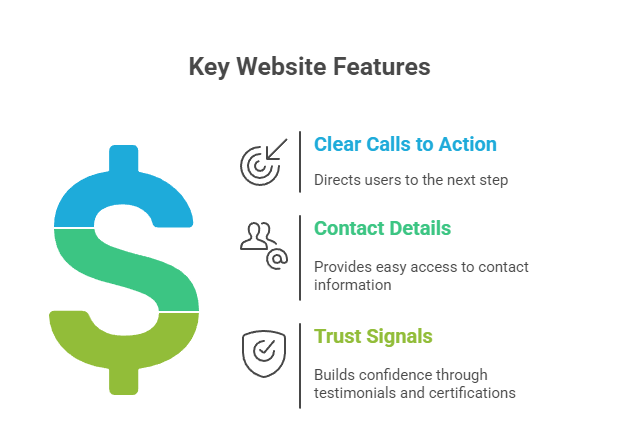
An excellent website goes beyond just looking good. It is necessary to have the right features that uphold the website’s usability, trust, and communication. These components enable the users to perform the desired action without any hesitation or confusion.
One of the most important features of a website is the presence of clear calls to action. Every major page should direct the users to the next step that can be getting in touch with the business, asking for information, or checking the services offered. CTAs need to be noticeable, straightforward, and very easy to understand.
Moreover, contact details should be the first thing visitors see. A good website makes it obvious what the business phone numbers and email addresses are or the most convenient contact method. If a company is operating from a certain location, it would be a good idea to include the address along with a map or direction to give customers more confidence and comfort.
Trust signals get to influence a great deal of the thinking that leads to a decision. Among these are testimonials, client logos, certifications, and security indicators. In general, they make the users feel secure, particularly, when they are required to share their private data.
Core pages are the ones which set up the framework of the site. Pages such as home, about us, service, and privacy policy are the ones that provide the website with a solid structure and openness. A transparent footer aids the visitors to get to the most vital links without the need to look for them.
It is important that forms are designed in such a way that anyone can fill them without much effort. By demanding too much the user will most likely abandon the process. An ideal form only takes what is necessary from the user and it is compatible with any device.
In addition, security features should not be neglected. The website that is connected through secure channels, has the latest updates for its software and is protected by the basic security measures is definitely a trustworthy place for users.
With the help of these fundamental components and expert website development services, a website is able to deliver a great user experience. They eliminate restrictions, empower the users and increase the business credibility.
SEO and Search Visibility Fundamentals
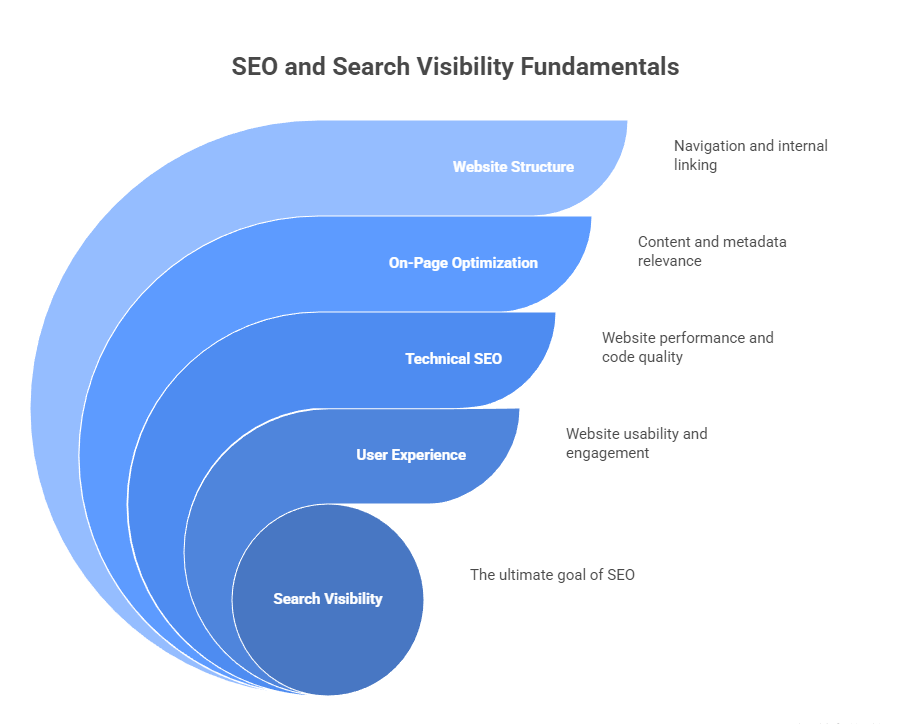
An excellent website should not be hidden in the vast web. The ability of a search engine to locate a website depends on the ways the website is built, its optimization level, and the search engine’s understanding of the site. Even with very good websites quality, without having proper SEO tactics and comprehensive digital marketing services in place, such kinds of websites are still capable to reach the audience they target only with a minimum of success.
How a website is structured is very important. Descriptive URLs, pages that follow a logical hierarchy, and being internally linked correctly are the factors that make it easy for search engines to crawl and index the content you have. A website that is properly organized helps the visitors as well in finding their way, which is an indirect benefit to SEO.
You cannot do without on-page optimization. The content of the page should be structured with the help of headings; every page should have a title and meta description that both describe the content and are relevant to it. Content should be focused on the user’s need and written in a way that the user gets real benefits of the content provided rather than simply placing the keywords.
One should not forget about technical SEO either. Quick loading of the pages, a design that works on different devices, and a code that is clean are the things that make your website be assessed as good by the search engines. Links that lead nowhere, duplicate pages, or bad performance may be reasons for dropping in search rankings.
With structured data, communication becomes easier. It helps machine reading of the data and can result in better display of the pages in search results.
What SEO is not about is taking shortcuts. The point is to make a website that does not confuse its users, a website that anyone can use, and a website that is of use to its visitors. If these basics are respected, then the presence in the search engines gets better automatically and is sustainable over time.
Security, Reliability, and Sustainability

An excellent website ought to be a safe and a steady one as well. People would want their data to be kept safe and the whole process to be smooth and without any hindrance. Whenever a web platform is short of both these aspects, security, and stability, the confidence which customers place in it may evaporate in an instant.
Security should be established with the most fundamental safeguards. Connections that are secure, updates that are done regularly, and forms that are secure are some of the ways that repelling usual attacks are made possible. People who visit a website will be more willing to interact there if they believe that their data is being taken care of in a proper way, especially when supported by reliable website development services.
Reliability is the measure of a website being there for the user, functioning, and loading in a proper way every time. The site has to be able to load in a proper way, work as it was tested, and be available at any time. Downtime, error occurrences, and broken features, therefore, a site’s reputation are the most harmful ways that a site’s reputation can be severely damaged, and, consequently, users get frustrated.
Security and reliability are closely linked chiefly because of continuous maintenance. By keeping things updated, fixing issues, and always looking out for potential problems, the site will be able to run smoothly for a long time even if there are continuous changes in technology.
Nowadays, Sustainability is getting more and more essential. By designing a site efficiently, using resources wisely, and taking care of the environment when hosting the website will result in less loading of the earth and will increase the survival of the website in the long term. A site that is sustainable will have fewer issues and thus, it will be more of a future-oriented site.
The three elements of security, reliability, and sustainability are like a support structure for a website that can be trusted. Provided that there is a proper implementation of these features, users will have the courage to go back to the site and to engage with it more and more over time.
How to Continuously Improve a Website
Moreover, user feedback cannot be left behind in the race. Comments, inquiries, and usability observations are the real problems that users face. Listening to feedback allows for content, design, and functionality adjustments.
Testing is the biggest factor in enhancement. Minor changes in the layout of the page, the wording of the headline, or the call for action can lead to a huge increase in the result. Directly by testing the companies can optimize gradually without the necessity of major changes.
Continuous improvement is all about being able to change. A website can still be in line with user needs and business growth by monitoring performance and making small changes.
Bringing It All Together: What Truly Makes a Good Website
A well-constructed site is basically the result of various factors that are functioning in harmony. No single characteristic can alone compensate for the deficiency of clarity, usability, or trust. The constituents of a website are similar to the pieces of a jigsaw puzzle that collectively shape the experience of the users.
Purpose is the main factor which determines the direction of a website. Design and navigation, on the other hand, are the elements which make the experience user-friendly. Performance is the factor that is responsible for keeping users engaged. Content is the factor that makes users trust the brand. SEO is the factor that attracts the visitors to the website. Security and reliability are the factors which give the website its safety seal. Continuous improvement is the factor that keeps everything up to date.
Perhaps the main feature that sets a good website apart from an average one is its balance. In the front, the website is all about users and thus, business goals get accomplished quietly in the background. The site is easy to use, clear, and reliable.
The websites have to evolve as the digital expectations of users are changing. Sticking to the basics rather than going after the latest trends is the key to being successful in the long run. If these principles are adhered to, a business website becomes a strong, reliable asset.
Conclusion
The quality of a website is mainly judged by how effectively it delivers the needs of the users and contributes to the achievement of business goals rather than by the looks alone. When a site’s purpose, user-friendliness, performance, content, and trust are all in harmony, it is a less trivial means of an online presence that a website becomes. By focusing on these core principles and continuously improving them through professional website development services, companies are able to build websites that are not only efficient and trustworthy but also socially and culturally relevant in a rapidly changing digital environment.
FAQs
1. What makes a good business website PDF?
A good business website PDF explains design, usability, content, SEO, and performance principles in a structured and easy-to-understand format for reference or sharing.
2. What are the 8 qualities of a good website?
The 8 core qualities are clear purpose, user-friendly design, mobile responsiveness, fast speed, quality content, strong SEO basics, security, and trust signals.
3. What are the 10 qualities of a good website?
A good website includes clarity, usability, mobile optimization, fast loading, strong content, SEO structure, security, accessibility, clear CTAs, and regular updates.
4. What makes a good website overall?
A good website is easy to use, clearly communicates value, loads fast, works on all devices, and helps users achieve their goals without confusion.
5. What is an example of a good website?
A good website example is one that has simple navigation, clear messaging, fast performance, mobile-friendly design, and helpful content focused on users.
6. What makes a good website checklist?
A good website checklist includes clear purpose, responsive design, fast speed, quality content, SEO optimization, security, trust elements, and easy navigation.
7. What makes a website bad?
A website becomes bad when it is slow, confusing, outdated, not mobile-friendly, hard to navigate, or lacks clear information and trust signals.
8. What are the characteristics of a good website PDF?
A good website characteristics PDF highlights usability, design standards, content quality, SEO basics, performance, and security in a structured format.